

How Rasayana Ayurveda Herbal Ghee Is Made | Ayurvedic Tradition
How Ghee Is Made: The Ancient Art of Rejuvenation
A slow simmer and gentle patience.
If you've ever opened a jar of ghee and inhaled that rich, golden scent, you already understand an ancient wisdom without even knowing it (yet). Ghee isn't just a cooking oil; it's a tradition and a labor of love that has been practiced for over 5,000 years.
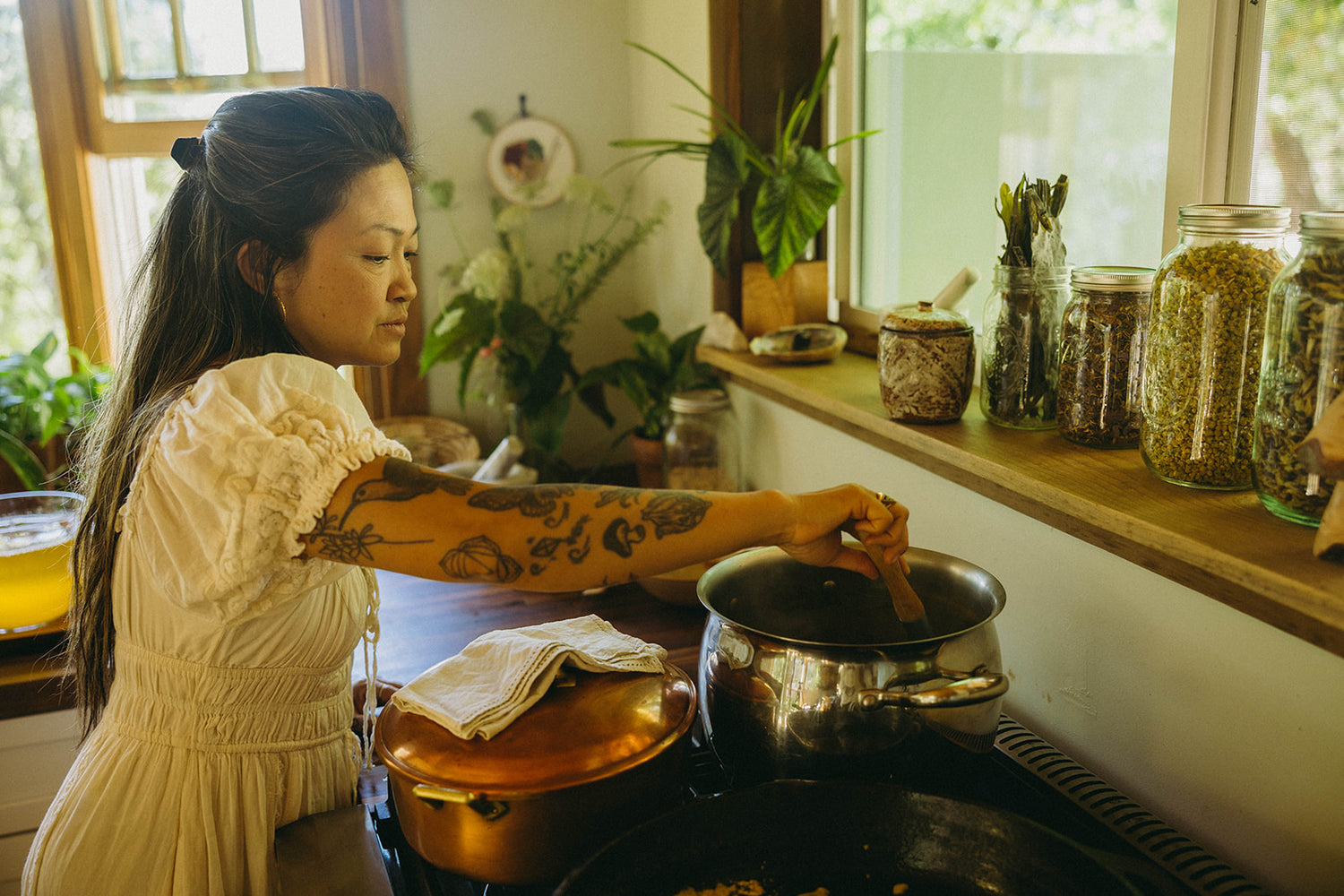
The process of making ghee is a ritual for us at Rasayana Ayurveda. We make it slow and intentional, ensuring that each batch is made with the full spectrum of beneficial herbs or wild seaweed.
What Is Ghee, Exactly?
Ghee is essentially clarified butter, taken one step further. While clarified butter simply has the water and milk solids removed, ghee goes the extra mile: the milk solids are allowed to gently brown before being strained away, infusing the pure butterfat with a warm, nutty, almost butterscotch-like depth of flavor and liquid gold color.
Think of it like this: butter is the raw material, clarified butter is the refined version, and ghee is the masterpiece.
Ghee is traditionally made from the milk of grass-fed cows, and it has deep roots in Indian Ayurvedic medicine, Hindu spiritual practice, and the kitchens of South Asia and the Middle East. According to ancient Vedic texts, ghee was considered the food of the gods. The grass-fed part is actually one of the most important distinctions between good ghee and great ghee.
Think of the grass as infused with the light of the sun that is eaten by the sacred cows which produce the milk that is made into ghee. This is why where the milk comes from is so important to our medicine making process.
How Our Ghee is Taken One Step Further
In the early stages of the rendering process, we carefully measure out the herbal ingredients or wild seaweed that will be simmered and infused into the organic butter as it cooks down and eventually forms into ghee. We use only the best herbal organic products to ensure that benefits and healing support is the most effective for the body.

Why the Process Matters: More Than Just Melting Butter
It would be easy to think of ghee-making as simple, melt some butter, skim off the foam, strain it. But the process is far more intentional than that. Each step serves a purpose, and rushing it changes the outcome entirely.
We also say a prayer with each batch, invoking peace and well-being for all beings on the planet--plants, animals and humans. It is important that our energy is clear and harmonious when we make our ghee and that we infuse each batch with love and reverence for the medicine we are making as our way to help heal the world.
1. Evaporating the Water
Butter is roughly 16–18% water. As ghee gently simmers, that water evaporates. This is crucial, it's what gives ghee its shelf stability. No water means no environment for bacteria to grow, which is why properly made ghee can last months at room temperature and up to a year in the fridge, with no preservatives needed.

2. Separating and Skimming the Milk Solids
As the butter melts and simmers, it naturally separates into three distinct layers: a foamy white layer on top (milk proteins), the golden butterfat in the middle, and more milk solids sinking to the bottom. The top foam is carefully skimmed away. This removal of lactose and casein (the milk proteins) is what makes ghee gentle for many people who are sensitive to dairy while also increasing its smoke point dramatically, from around 300°F for regular butter to over 450°F for ghee. This makes it exceptional for high-heat cooking without burning.
3. The Maillard Magic — Browning the Bottom Solids
Here's where ghee becomes something truly special. Unlike clarified butter, which is strained as soon as the fat runs clear, ghee is cooked just a little longer. The milk solids that settle at the bottom of the cast-iron pan are allowed to gently brown through what scientists call the Maillard reaction. The same beautiful chemistry responsible for the crust on bread and the sear on a steak. This is ghee's signature liquid gold essence!
4. The Final Strain
Once those milk solids have done their job, they're strained away, typically through cheesecloth or a fine mesh strainer, leaving behind only the pure, luminous butterfat. What pours into the jar is ghee: clear, golden, fragrant, and utterly alive with flavor.

Why the Quality of the Butter Matters
Ghee is a concentrated product — which means the quality of your starting ingredient is everything. Low-quality butter makes mediocre ghee. High-quality, grass-fed butter from well-cared-for cows makes transcendent ghee.
Grass-fed butter tends to be higher in fat-soluble vitamins like A, D, E, and K2, and richer in conjugated linoleic acid (CLA). It also has a richer yellow color (from beta-carotene) and a deeper, more complex flavor — all of which carries through into your ghee. This is why sourcing matters deeply to us and it's why we're intentional about every single batch.
More Than a Cooking Fat: The Soul of Ghee
To reduce ghee to a mere ingredient would be to miss its soul entirely. In Ayurvedic medicine, India's ancient system of holistic healing, ghee is considered one of the most sattvic (pure and balancing) foods. It has been used for centuries to aid digestion, nourish the body, and calm the mind.
Why We Make Ghee the Way We Do
At Rasayana Ayurveda, we believe that the best ghee cannot be rushed. We follow the traditional slow-simmer method, watching, listening, and trusting the process because we know that's where the flavor lives. We start with the highest quality grass-fed butter we can source, and we tend to every batch with patience and care.
The result is ghee that doesn't just cook your food — it transforms it. Whether you're sautéing vegetables, stirring it into morning coffee, spreading it on warm toast, or drizzling it over rice or lentils the way grandmothers have for generations, our ghee brings something irreplaceable to the table.

Ready to Taste the Difference?
Now that you know the 'how' behind ghee, we hope you have a deeper appreciation for every healing, golden spoonful. The slow simmer, the careful skim, the patient watch, it all comes together in that one jar of liquid gold.
Explore our collection and taste ghee the way it was always meant to be made: slowly, intentionally, and with love.
· · ─ ·𖥸· ─ · · · · ─ ·𖥸· ─ · · · · ─ ·𖥸· ─ · · · · ─ ·𖥸· ─ · · · · ─ ·𖥸· ─ · · · · ─ ·𖥸· ─ ·
References
Yokogawa T, Yamazaki C, Hara M, Sakashita Y, Tanikawa T, Suzuki R, Inoue Y, Kitamura M. Effect of Maillard reaction on the quality of clarified butter, ghee. J Nat Med. 2023 Jan;77(1):230-237. doi: 10.1007/s11418-022-01661-y. Epub 2022 Nov 3. PMID: 36324007.


